
Rope Mallakhamb
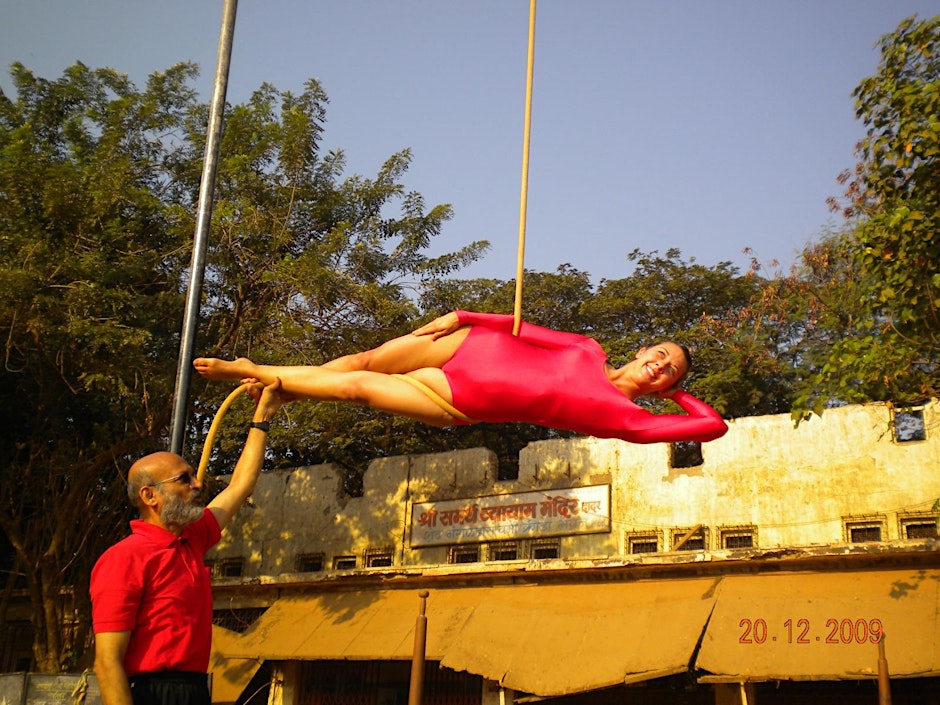
Rope Mallakhamb, popularly known as Rope Yoga, is an ancient Indian form of Indian physical culture that originated in India’s Maharashtra about a hundred years ago. The original form of it is Cane Mallakhamb, where yogic postures and acrobatic exercises were performed on a finger thick smooth cane. Guru Damodarbhatt Moghe, a disciple of Balambhattdada Deodhar, is the founder of Mallakhamb, having rediscovered Cane Mallakhamb. In the last 30 to 40 years, the cane has been replaced by a rope, due to the unavailability of specific types of canes.
Apparatus
The rope is specially made of cotton, covered with a canvas coating, and it is approximately 6 meters long (18 feet). At one end is a round loop while the ‘tail’ end is made a little heavier by interlocking plates. It should be hung vertically from a firm support at a height of 16 feet so that at least 2 feet of the tail is lying on the floor. Rubberised coir, cotton or sponge mattresses are laid below the rope to ensure safety. Typically, powdered roison (a clear, crystallised, sticky substance) is applied to the rope to give its surface increased grip and to prevent it being slippery.
Precautions
Initially the exercises on the rope should always be practised under the expert supervision and never be attempted alone. The attire should be comfortable, tight shorts or trousers and a T-shirt. One should not start practising on the rope on empty stomach or immediately after full meals. While learning or practising on the Rope, atmost care should be taken, so that the palms or toes should never slide on the Rope in order to avoid bruises, blisters or serious injuries.
Exercises on the Rope
I) *Vertical Positions*
1) Climbing on the Rope – i) Using the Palms and Toes, ii) Using only palms, iii) Straddle L or Padmasan Climb, iv) Ek Pad Shirshasan Climb, v) Inverted Climb vi) Shidi (Ladder climb)
**2) Straddle L **– i) Hanging Straddle L, ii) Jump to Straddle L, iii) Jump Half Turn Straddle L iv) Jump Full Turn Straddle L
*3) Steady Positions:* i) Standing Shavason, ii) Standing Paschimottanasan iii) Simple Cross iv) Upper Cross v) Padahastasan vi) Paschimottanasan vii) Padmasan viii) Ek Pad Shirasan ix) DwiPad Shirasan x) Garbhasab xi) Natrajasan xii) Hastapadangushthasan xiii) Shavasan xiv) Dhanurasan xv) Nidrasan xvi) Shayanasan
4) *inverted positions*, i) Sadhi Udi ii) Shirshasan iii) inverted Vrukshasan iv) inverted Parvatasan v) inverted Buddha Padmasan, vi) inverted Matsyasan, vii) Dweepad Pavanmuktasan or Katti pakkad ix) Nishani (Ulti Udi), x) Inverted Hang (Angasafa) xi) Angasafa Plank (Back Fish)
*4. Hanging Positions* i) Bajrang Pakad, ii) one leg rikeb – transition to Natrajasan, Hastapadangushthasan, ekpadshirasan, suptatrivikramasan
iii) Rikeb with both the legs iv) Vadi, v) Guru Pakad vi) Guru Pakad Plank vii) Waghul Udi *Benefits of Practicing Rope Yoga:* All the benefits of practising Yoga are achieved while practising Rope Yoga and in addition to that since Rope Yoga is practised few feet about the ground, it requires constantly pulling the body upwards against the force of gravity. Hence Core strength l is developed, it also develops the courage and confidence. Increase in core strength. Stamina, speed, flexibility, neuromuscular coordination, balancing ability etc are additional advantages. It is proved that yoga is the best exercise for the spinal cord which is considered as key of good health. Regular practice of rope yoga increases the disease resistance power
Uday V. Deshpande